
What is dark data?

Unpublished research creates gaps in what we can learn.

“Dark data” - a term originally used to describe lab notes and experimental findings left untouched in filing cabinets and drawers - includes negative, null, and inconclusive results that never reach journals, preprint servers, or searchable databases. When these findings remain hidden, they can lead to duplicated effort and leave important gaps in the scientific evidence base.1

The Null Compass is a tool of the Null Hypothesis Initiative - a multistakeholder program working to make these results more visible in the fields of clinical medicine and biomedical science. Learn more about the Null Hypothesis Initiative and the 501(c)(3) Center for Biomedical Research Transparency that hosts the initiative on our initiative and organization page.

Are you sitting on Dark Data?

Start making science better... Today!

Use the Null Compass to get help writing up your research AND qualify for a microgrant!

Start the Compass
  1. Answer some questions

    Answer an adaptive questionnaire about your study design, findings, context, strengths, and limitations of your work. Yes, methodological failures are still important!

  2. Review your reading

    Receive your null research classification, suggested publication pathways, an inspiration "draft" abstract, and receive your Null Compass registration code.

  3. Publish your work

    Submit your work for publication or pre-print, and obtain a DOI for your research. Submit that DOI alongside your Null Compass registration code - and receive your $500 microgrant!*

What will you get?

You will get encouragement!

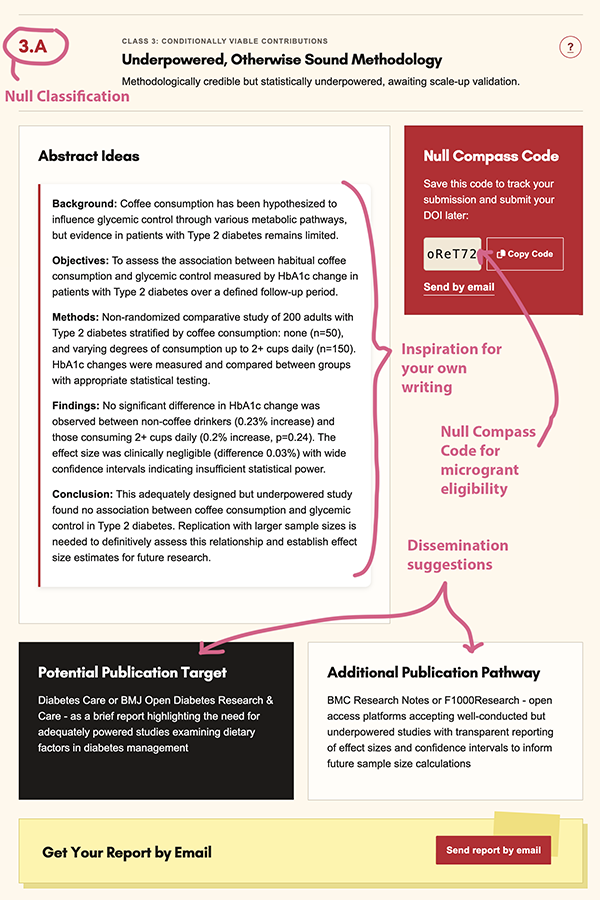
The Null Compass will organize the information you provide into a starting point for your own review, classify your findings against the negative & null results framework, and give you a gentle nudge in the right direction for potential submission.

Explore the classification framework

Example Null Compass report showing a null classification, abstract ideas, a Null Compass code, and publication pathway suggestions
The opportunity

A reward for making science better.

Null and negative findings are part of the scientific record - but too often, they never become part of the discoverable record. The Null Hypothesis Initiative is offering a limited set of $500 microgrants to researchers who take the full publication journey from Null Compass through to DOI, helping us understand more about the dark data that exists while making more of the scientific record available to future researchers.

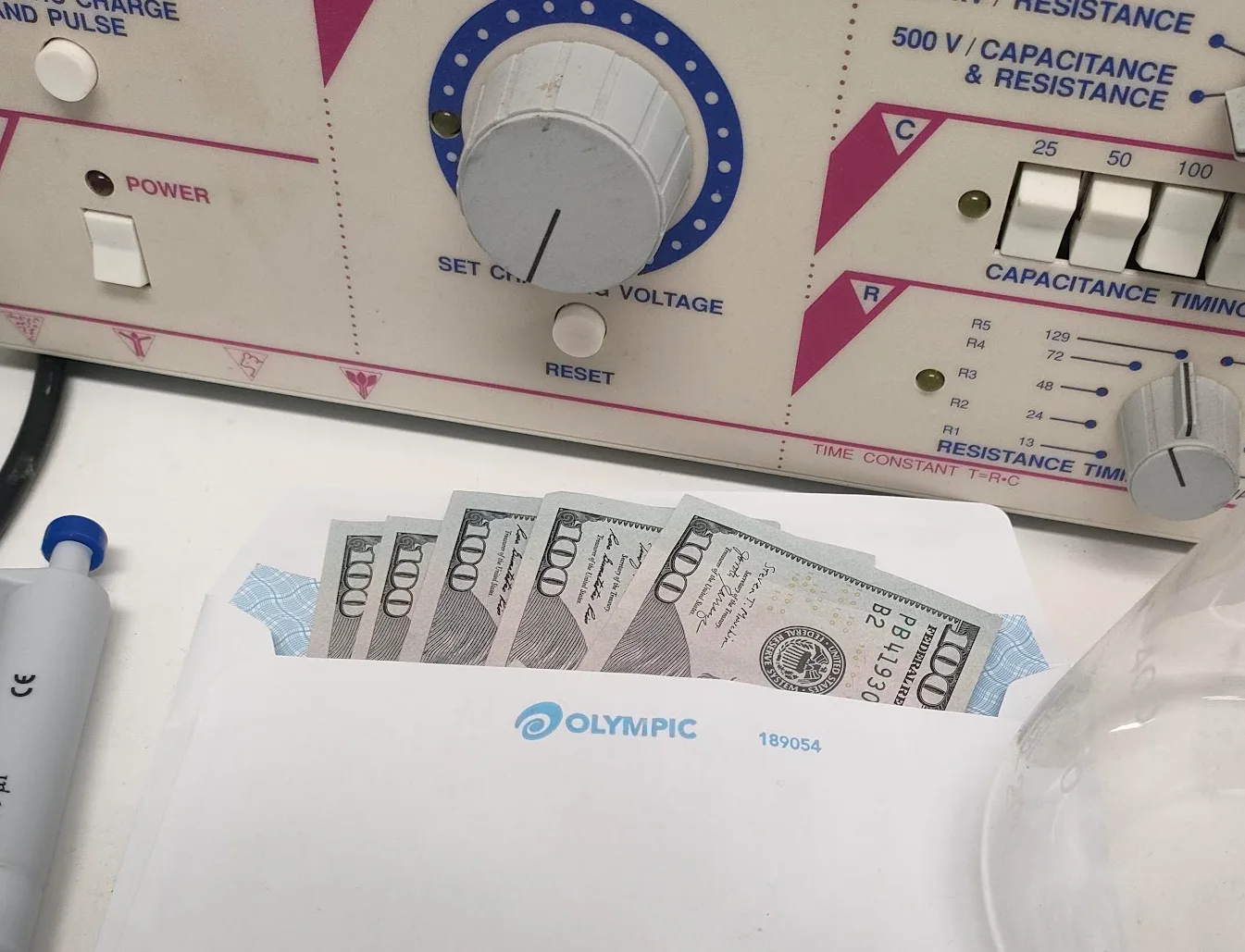
Five hundred US dollars in an envelope on a biomedical laboratory bench
NULL HYPOTHESIS

In publication...

Neurology® 9 Jun 2026 H₀ supported publication

Cerebral “Dirty-Appearing” White Matter in Relation to Cognitive Decline and Dementia Risk in Community-Dwelling Older Adults

Ingmar Eiling, Sigurdur Sigurdsson […]

Cerebral “dirty-appearing” or “diffusely abnormal” white matter (DAWM) represents subtle white matter abnormalities that are associated with progression of cerebral small vessel disease (cSVD), but the association with cognitive function and dementia is unclear. Our aim was to study the association between DAWM and cognitive function, long-term cognitive decline, and long-term dementia risk in community-dwelling older adults with limited baseline cSVD burden.

Neurology® 12 May 2026 H₀ supported publication

Functional Outcomes After Intensive Blood Pressure Reduction in Deep and Lobar Intracerebral Hemorrhage

Santiago Clocchiatti-Tuozzo, Adnan I. Qureshi […]

Intensive blood pressure (BP) reduction may reduce the risk of poor functional outcomes in patients with acute intracerebral hemorrhage (ICH). Whether these potential benefits apply similarly to lobar and deep ICH, 2 biologically and clinically distinct subtypes, remains uncertain. We tested the hypothesis that intensive BP reduction has differential effects on functional outcomes based on ICH location.

Neurology® 28 Apr 2026 H₀ supported publication

Idiopathic Intracranial Hypertension Prevalence and Hormonal Contraception

Andrew Mihalache, Ryan S. Huang […]

Women's health advice in people living with idiopathic intracranial hypertension (IIH) is inconsistent, primarily due to an enduring concern that hormonal contraception (HC), including oral contraceptive pills (OCPs) and hormonal intrauterine devices (IUDs), might be associated with a higher prevalence of IIH. This systematic review and meta-analysis examines whether a meaningful association exists between HC use and IIH prevalence.

Neurology® 28 Apr 2026 H₀ supported publication

Long-Term Exposure to Ambient Air Pollution and Incident Amyotrophic Lateral Sclerosis

Christos V. Chalitsios, Oliver Rudolf […]

Amyotrophic lateral sclerosis (ALS) is a neurodegenerative disease with a complex etiology. Although a range of genetic and lifestyle factors have been implicated, the potential role of environmental airborne pollution exposure is uncertain. This study examined the association between long-term ambient exposure to air pollutants and the incidence of ALS in UK Biobank participants.

Circulation 25 Nov 2025 H₀ supported publication

Biomarker-Based ABC-AF Risk Scores for Personalized Treatment to Reduce Stroke or Death in Atrial Fibrillation: A Registry-Based, Multicenter, Randomized, Controlled Study

Jonas Oldgren, Ziad Hijazi […]

The clinical use of risk scores to guide treatment decisions and improve clinical outcomes has rarely been prospectively evaluated. This study aimed to evaluate whether a biomarker-based ABC-AF risk score–guided multidimensional treatment strategy improves long-term outcomes in patients with AF.

Neurology® 11 Nov 2025 H₀ supported publication

Effect of Mobile Stroke Unit Dispatch on Process Parameters and Functional Outcomes in Patients With Acute Stroke

Jessica L. Rohmann, Marco Piccininni […]

Prehospital stroke management on mobile stroke units (MSUs) shortens time to IV thrombolysis (IVT) and improves functional outcomes. Because IVT effects are time-dependent, optimizing workflows and dispatch-related processes may enhance MSU benefits. The B_PROUD-2.0 study aimed to determine the effect of additional MSU dispatch on functional outcomes in acute stroke patients under optimized MSU organization and service delivery.

Reference

Bowers EC, Stephenson J, Furlong M, Ramos KS. Scope and financial impact of unpublished data and unused samples among U.S. academic and government researchers. iScience. 2023;26(7):107166. https://doi.org/10.1016/j.isci.2023.107166